Showing posts with label delayed healing. Show all posts

Tuesday, November 20, 2012

A FUNGUS AMONG US

We know I am a slow writer. But I'm also a slow healer — something I never knew until my bilateral mastectomy nearly 22 months ago. It's been one long, bloody (in the British sense) battle after another with this right (aka "problem child") boob of mine.

After struggling for months with delayed healing followed by the loss of my right tissue expander followed by the replacement of said expander followed by additional delayed healing, it goes without typing that I was greatly anticipating the surgery to exchange my tissue expanders for permanent implants. (Why do they make "exchange" sound so simple anyway, like going in for an oil change?) Turns out I was more afraid of this "exchange" surgery than any of the others. My butterflies felt more like...

Monday, July 16, 2012

GIVING UP THE GHOST

The last I wrote of my journey with reconstruction (see Delayed Healing), I was trying in vain to save my right tissue expander. Allow me to catch y'all up on my physical progress since then. I'm including photos to help anyone out there who may be struggling with delayed healing issues. First, let's backtrack to a year ago.


July 6, 2011
July 2011 My original right incision never healed closed after my mastectomy on February 3, 2011. After repeated surgical interventions to debride and re-suture and heal it, a pinhole developed through which fluid seeped at a consistent pace. The pinhole grew from a tiny dot to the size of a large pinhead (see photo). Because it is an actual hole and not just yellow/green tissue (see Delayed Healing for pictures of that), my plastic surgeon, Dr. C., and I decide it is time for the right tissue expander to finally come out. I make peace with this decision.


July 6, 2011 In the hospital under anesthesia, Dr. C. cuts into the healed portion of my old mastectomy scar, excises the expander and scrapes away the scar tissue that has built up over the past five months. This tissue will be sent to the lab to make sure I don't have an undetected infection as well as to check for cancer cells. 

This is my fourth surgery on this side (not counting in-office stitching). The fourth time I undergo general anesthesia in as many months. The fourth time I try in vain to heal this wound. (But who's counting. Oh right. Me.)

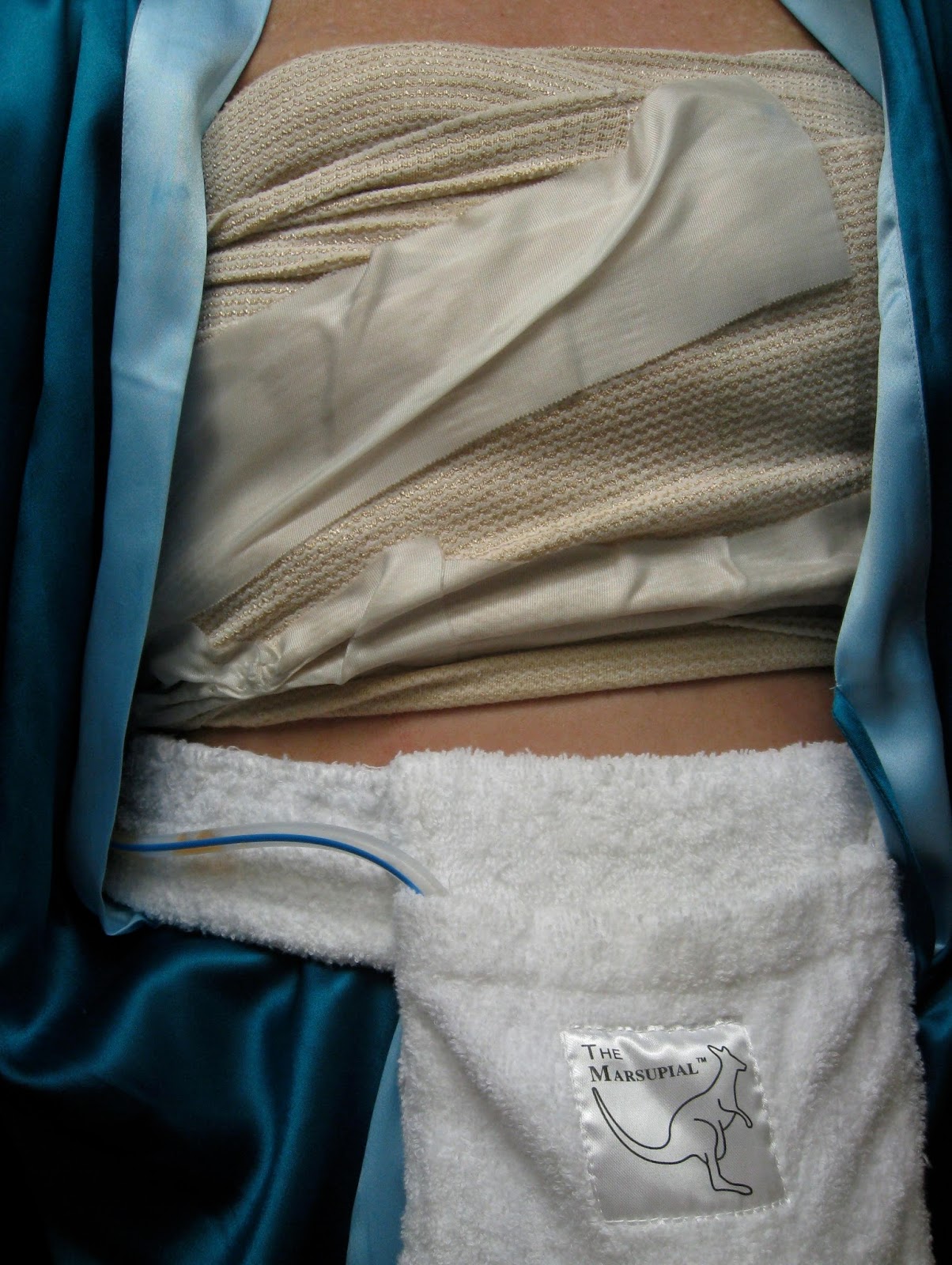
I wake up and don't feel nauseous (always a sign of operational success!) and am sent home a few hours later. With another damn drain in a different place (which means another awful scar). I'm wrapped tight as a mummy in an Ace bandage and not allowed to shower. Which is alright by me, because I'm dreading having to look at my mutilated self.


July 10, 2011
Despite the internal and external trauma of delayed healing and the subsequent removal of my tissue expander and scar tissue, the AlloDerm that Dr. C. placed in righty during my mastectomy is holding up just fine. That's the good news. But I'm now left with a crescent-shaped mound resting above my inframammary fold line, and a sagging, scarred pile of skin above it. Just call me Uneven Annie.

Time passes. My incision heals. For. The. First. Time. EVER. (I guess my body really didn't like that right expander.) My biggest challenge now? Disguising the fact that I'm now a one-boobed wonder when I leave the house.


The easiest way around this is to wear a structured bra that clasps in front. (This workout bra is by Danskin; I bought it at Walmart.) I don't fill out the cups, but that doesn't matter; when I wear this baby, I look "normal" in clothes. Only when hugging me would you notice a dent. (So I don't hug too many people.) The plunge design of this bra allows me to finally wear regular tops. (I've been living for months in surgical vests 24/7... they provide compression for the fluid build-up and a way for my bandages to stay put. I will not miss them.) What a relief to leave button-down shirts on the hanger.


November 30, 2011
I also begin physical therapy twice a week to regain the range of motion on my very weak right side. And I'm beyond relieved to hear neither infection nor cancer is found in my scar tissue.

December 1, 2011 One week before my one-year cancerversary (see that post here), I have my fifth surgery. Dr. C. inserts a new right tissue expander and fills it to 200 ccs (rather than the original 350 ccs like my other side). For the first 25 days, all goes swimmingly. My incision looks to be healing. I'm back in my surgical vest and recovering while also preparing for Christmas. But I overdo it, eagerly handing out gifts from beneath the tree I also helped decorate. What was I thinking? I notice a tiny spot of yellow on my bandage that night.


January 5, 2012
December 28, 2011 I notice a larger yellow spot on my gauze pad this morning. Here's the weird thing: The spot isn't on my fresh incision line. It's along my OLD incision line — an area that wasn't even cut during my last surgery! Truly, this is my Achilles heel. I feel like I just found out someone or something died: My hope.

Despite all this, and for reasons unknown, the tiny area does not develop into an actual hole like it has so many times in the past. It simply weeps. Kind of the way I do when I stop to think about how long I've been struggling. I use less antibiotic ointment this time around because I read somewhere that too much can inhibit healing. Dr. C. doesn't think this has anything to do with it, but I'm willing to try. Maybe this is why it's not getting bigger?


February 29, 2012
February 2012 Sometimes I have seepage after I shower, so I cover my incision with a big, waterproof bandage. Afterwards, I have to press down on the area above my expander to force out the accumulated serum that continues to build up inside and around my expander. Still, the area continues to improve. (Fat fingers crossed.) A yellow scab forms. I am cautiously optimistic. 

But the feeling is fleeting.


March 5, 2012
March 1, 2012 I shower with my waterproof bandage, and afterwards dab alcohol gingerly around the tiny scab. Lo and behold, the tiny scab comes off. Yippee! This means I'm healed! I quickly grab my magnifying mirror — and to my horror I see there is a tiny black hole instead of fresh tissue. Healed skin never resided behind that scab; it was all just an illusion. 

I almost drop the mirror. Instead, I start to cry. I can't take this anymore. I have been tolerant. I have been compliant. But it's been 13 bloody (in the British sense) months and I'm SO over this physical and metaphorical black hole. Part of me wants to keep denying that I've got a medical problem with no solution. Another part of me is pissed off and ready to take on someone, anyone, by the horns. The rest of me is just tired. Luckily I have an appointment in a few days with Dr. C. He will know what to do!

March 6, 2012 I'm feeling frustrated, confused, impatient — dare I say it: I'm in a mood. My pinhole continues to ooze. I explain the whole thing to Dr. C. He listens. He empathizes. He looks. He presses. He squeezes. Then he shakes his head. I have never seen him this perplexed or down. Then he drops the bombshell: He is not sure what to do with me.

What do you mean, you don't know what to do with me? You're a doctor! I'm doing everything right and this is all very wrong. I say nothing about getting a second opinion, but I'm absolutely thinking it — and he must be a mind-reader because he suggests I get one. (How many doctors do you know who are willing to tell you that? It takes a lot to admit defeat. Or at least profound frustration.) I'm also wondering why he hasn't shared my case with other surgeons and collectively figured this out. Again, he reads my mind: He tells me he has a colleague at UCLA that he wants to discuss my case with. 

I would like both of those things: A second opinion, and you discussing my case with your colleague. There. I said it. And man, it feels good.

Newly energized by anger, I go home and contact a friend who had reconstruction (see my Get This Party Started! post). She gives me the name of her doctor. As I'm about to dial his number, my gut interrupts: Don't call this guy. Why? Because I suspect he's the same surgeon that Dr. C. is going to confer with. I don't make the call. I listen to my gut.

I turn my attention to a woman I know online who is an expert on tissue expanders. In addition to her vast technical knowledge, she keeps a database on leading surgeons (as well as clunkers who should never work on a woman again) in dozens of cities across the U.S. She tirelessly volunteers her time helping breast cancer patients navigate the tricky, murky waters of TE Land. I lay out my tale of woe and ask for a referral or two in my area.

She emails back the same day, but I am unprepared for her reply: "I think you need to give up the ghost on implant-based reconstruction only. There is some reason your body is reacting in this manner and I do not think that current methods of trying to resolve the problem are working now or will work in the future."


March 13, 2012
And, just like that, my merry-go-round comes to a screeching halt.

I'm in a funk for three days. Pissed that someone could thwart my hopes to heal with one blunt email. The truth is, I'm unwilling to undergo more drastic surgical measures to "fix" my problem (i.e., a skin graft from my back, or taking fat from my belly to make a boob). I'm stubborn. I've been suffering through this for far too long to just "give up the ghost." But maybe that's exactly what I should do. Give up the ghost of what I want for what I can realistically have. (Like getting cancer wasn't enough of a kick in the mouth! This whole recon thing ain't for the faint of heart.)


March 14, 2012
March 14, 2012 Something amazing and unthinkable has happened overnight. My pinhole is no longer a pinhole. My incision is closed. CLOSED I tell you! I can't believe it. I was religious about taking photos of myself throughout this process; see it for yourself.


Miraculous, right? Guess I had to get good and mad in order for my body to release its need to seep. I was living in limbo land for so long that when I finally stopped crying and feeling sorry for myself, so did my body. And in that moment I took back my control. I was able to let go emotionally. And I began to heal.


March 27, 2012
March 27, 2012 I see Dr. C. again. He is visibly concerned about my plight. (He doesn't yet know that my pinhole has healed. I don't tell him; I want to hear what his colleague had to say first.) I'm sitting in my unopened, button-down shirt. Before he begins, I ask what the other surgeon's name is. (HA! I was right. It is the same surgeon who operated on my friend. The gut never lies!) Dr. C. says both he and the other Dr. C. think I need a Latissimus Dorsi Flap due to my compromised healing. And that's when I open my shirt. I flash him my healed incision and stop him cold in his tracks. (How often do you get to flash an unsuspecting man?) His mouth literally drops open. He is shocked speechless. He knocks on the wall for luck. "This is completely unexpected," are about all the words he can muster.

I no longer want a second opinion. (Kinda already got one.) The seeping and weeping has ended. I am healing. It will take a few more months. I can do this.


July 15, 2012
July 10, 2012 I see Dr. C and it's official: I am completely healed! Here the hitch: During normal reconstruction, saline is injected into tissue expanders over a period of time to stretch the skin and help prepare it for final implant surgery. I have 350 ccs on my left side from my first surgery, and 200 ccs on my right side from my TE reinsertion surgery. This is not ideal because A) they are not very big and B) they are uneven in size. I won't be as big as I was before, but Dr. C. is confident he can make me match (using implants only) on the surgery table, and with a good result. I do not need a skin graft. If I didn't trust this process completely before today, I do now.

Dr. C. does not want to compromise my skin integrity by stretching me further, so I will not be getting fills every couple of weeks like we originally planned. He has, however, decided I can have one fill (more for the experience, I think, than anything else.) Though he's never allowed a patient to do so before, he lets me push the saline through the syringe, giving myself the long-awaited 50 cc fill on each side. (It's only been 17 months. What's my hurry?)
(Illustration courtesy of Breastcancer.org; all reconstruction photos © 2012 The Big C and Me)
On that note, my friends, this blog is officially up-to-date with my real life. It is tracking true to life events. (That's something I've been trying to do since I started writing back in April of 2011.)

When I finally have my exchange-to-implant surgery (didnt I tell you? It's scheduled for September 5, 2012!), my posts will be in real time. 

Woot woot!

EDITED TO ADD: To read what happens after my exchange surgery, click here.


Monday, March 5, 2012

DELAYED HEALING

Alas, I do not have much room in my brain to fully ponder the notion of not going to the Cancer Center for 180 days. Why? Because my beautiful new incision (read about that here) is not healing again. (Warning: There will be pictures involved.)
Trouble starts up again: The telltale yellow spots.

Three small yellow/green spots (not infection, but excess collagen which is interfering with my body's ability to close my skin) develop along my right incision line. I continue to keep it sterile and covered with antibiotic ointment and Xeroform and plenty of gauze (which I have to change every few hours, because the fluid my body is producing is leaking through the spots in my incision. Kind of like having a bad period, but continuously).

I keep Dr. C.’s office informed, and I monitor my progress (or lack thereof) by photographing my incision line each morning. I also rest more by taking a long nap every afternoon.

Can I just say how hard it is to try and lose weight when I have to eat more food rather than less? Dr. C. told me that healing "is not the time to restrict calories." And getting in 100 grams of protein a day — protein promotes healing — means eating every three hours. (See my Top 10 List.) I can’t lift anything using my right arm because the incision is still healing. No pulling, no pushing, no carrying with that arm. No upper body exercise aside from gentle stretching. Walking is fine, as is the elliptical (but no arms).

I still feel semi-exhausted most days. Though I realize I've been under anesthesia twice in the past month (4 ½ hours total), in my mind I feel like I should have more energy. The old me is having a hard time accepting the new me.

Three spots converging to become one.
And I continue to document my progress with my digital camera. I highly suggest this practice.

After several weeks, I notice my revised incision is not healing properly. The yellowish green spots have merged, colliding to become one larger spot. Dr. C. doesn't like the look of it. He wants to "debride" (i.e., clean up) the unhealed area and re-suture my incision line. Again.

I'm pleased he’s taking the precautionary road and we are dealing with this surgically (my other choice: continue to take a "wait and see" approach while continuing to use a special “debriding” ointment, but that doesn't seem to be helping), but I’m not happy about having a 3rd surgery.

Quarter-sized spot
The spot grows to become the size of a quarter (see photo at right). So five and a half weeks after my last incision revision (and 8 weeks after my bilateral mastectomy), I am wheeled for a 3rd time back into the operating room. The staff is familiar to me now. They recognize me. “Oh, I remember you!” (Nothing like being famous in the OR.)

Dr. C. debrides the area and re-sutures the skin. (And yes I'm loosing a little skin each time he does this.) He removes another 50 cc's of saline from the right tissue expander, reducing the pressure further in an attempt to get it to heal.

My right tissue expander is now less than half the size of the left. Yes I am very lopsided and that makes it difficult to disguise in clothes. (As if having coconut shells on my chest weren't enough, mine seep and are different sizes! Oh the joy!) I buy a heavily padded bra that I wear to give the illusion of a normal shape. (Just don’t hug me.) But most days I live in my surgical compression vest — which I still must wear 24/7.
Newly debrided, re-sutured incision

My new incision, however, looks beautiful (see image at right)! I am told to focus on getting back to life: keeping up my protein intake, walking, trying not to do too much around the house (I have to force myself to limit movement of my right arm so I don't put undue pressure on the new stitches). My energy is coming back despite having 5+ hours of anesthesia in two months. I’m back to hiking twice a week.

But as all things in the world of cancer, nothing ever goes as planned. Several weeks pass and again, the tell-tale spots. (What a sinking feeling that is.) The spots are small, and do not advance as quickly as in the past, which is good (and I make note of), but still, it's hard to ignore the fact that this incision does not want to heal. (My other side? Completely fine, still.)

With spots come seepage. It's almost like my incision is weeping along with me. The seepage seems to be tied directly to how active I am. If I work at the computer and then take a nap, it doesn’t leak; if I take a hike, make a salad or drive to the grocery store, it does leak. How much of a prison can I live in? I vacillate between doing nothing for days on end, and trying to be normal (save from using my right arm). And still I leak. Labs show no sign of infection, BTW.

I am a patient woman, more patient than most, but WTF? Seriously, I am so over this. There have to be other women out there who are struggling with these healing issues too. Sure enough, I head online and start a thread within the BC group for tissue expander problems (aka “delayed healing”). Once I connect with others in my situation, I feel far less alone, knowing these ladies "get" the frustration I am wallowing in. Some had infections that prevented their healing; some had allergic reactions; some experienced rejection of the expander (their body viewed it as a foreign object); some had an expander that sprung a leak (it happens!); others had thin skin due to radiation or surgery — the latter of which we believe is the cause for my troubles. My surgeon scrapped as much tissue out of my affected breast as possible during my mastectomy (I told him I didn’t want any tissue left for bad cells to move into so get it out, please — and he did). But now there doesn't seem to be enough circulation in the thin skin that surrounds my incision.

Dime-sized hole in my incision.
Despite the exercise, the protein, the non-use of my arm, the naps and my (generally) sunny disposition, my incision doesn't heal. The main spot widens to the size of a dime. (Better than a quarter! See photo at left.)

Office stitches
I know I can heal this if Dr. C. reinforces the center of the spot — so he gives me a four blue stitches (in his office this time, no anesthesia, and yes I was scared).

I have been wearing my surgical compression vest and changing my gauze dressing for 5 long months. I can do it a little longer.

Husband and I decide to take a short trip to Las Vegas to celebrate our anniversary and take my mind off my healing. It works; I am able to completely forget I have cancer (seriously!) and I feel like the old me. It was fabulous.

Except when it wasn't. We were walking a lot, so, natch, the seepage increased. (We went to a show one night, and I was seeping so much I had to stuff a washcloth in my big bra to safeguard against leakage.)

The "What happens in Vegas, stays in Vegas" addage apparently doesn't hold true for me. I make an appointment with Dr. C. to discuss said seepage. He removes my pretty plastic stitches and says the incision looks great, but is concerned that the incision is not sealed. He explains that because my skin is so thin, any buildup of fluid will exit at my weakest point.

We are bandaging the wound differently for the next few weeks to see if it heals any differently.

Then we start talking about Las Vegas. (Funny, I don't remember telling him I was going.) I say it was great to get away. He asks how we liked the Wynn. What? How does he know we stayed at the Wynn? I look at him, perplexed. He keeps going. “You were on the 60th floor, right?” Whoa. What? "How do you know that?" I ask. He laughs and says he saw my husband and me get on the elevator just as he and his wife were getting off. He called out to us but then the elevator doors closed.
He figured I didn’t recognize him in his pool shorts. (He would be correct; I usually see him in a suit.) I added that had I seen him, though, I would have told him I had a washcloth stuffed in my bra! We had a good laugh.

When I tell Husband the story, he laughs too, then has a vague recollection of a guy in a straw hat, waving at us from an elevator. Small world, isn't it?

Saturday, February 25, 2012

DO I NEED CHEMO?

In my quest for catharsis, I'm finally picking up where I left off (on the heels of my delayed healing issues). Here's what happened next on my breast cancer journey:

I'm sitting in the lobby of the cancer center, waiting to see Dr. D., my oncologist. I will soon learn four crucial pieces of information:

1) My BRCA test results
2) My Stage
3) My Oncotype Dx score
4) Whether or not I need chemo

Husband is with me. In a moment of tenderness, he asks if I am OK. "I can handle anything Dr. D. has to tell me." Husband is as surprised to hear me say this as I am! In the months since my diagnosis, I have researched, read, lived and breathed breast cancer. I’ve been in touch online with countless women with a similar diagnosis. And it's because of these women that I am able to sit in this waiting room and feel a solid wall of strength supporting me. These ladies have my back. I'm really not afraid. Which is a pretty darn good way to walk into an oncology appointment.

Dr. D. is a man of few words. He looks me straight in the eye and answers every one of my questions.

1) I am BRCA1 and BRCA2 negative. That means I do not carry the gene mutation responsible for some breast and ovarian cancers. Whew!

2) I am Stage 1B. Because my tumor was 3.2 centimeters, it pushed me from Stage 1A (where the size limit is 2 cm) to Stage 1B. Still, it's great news; I am over the moon! Waiting for that number affected me on such a deep level that I don't even think I was fully aware of it. I just know that in that moment, I feel relief for the first time since I was told I had clear lymph nodes.

3) My Oncotype score is 16. That means I have a 10% risk of distant recurrence — and puts me at the high end of the low-risk group. There are 3 risk groups: low, middle, and high. If my number fell anywhere in the high-risk group, I would be given chemo; if it fell anywhere in the middle group, chemo would definitely be weighed as an option; but because my number fell in the low-risk group (albeit the high end of the low-risk group), studies have shown that chemo may do more harm than good.
4) I don't need chemo. Given my age (52), low tumor grade (1), low cancer stage (1B), perimenopausal status, and bilateral mastectomy, Dr. D. says that statistically there is no benefit to giving me chemo.  WOW.

I had an intuitive feeling about this; I have felt all along that chemo would do my body irreparable harm. Hearing Dr. D. tell me I don’t need chemo is a huge, huge relief. (Not to mention that it validates my intuition.) Husband is visibly relieved.

5) I don't need radiation. Even though I had a double mastectomy, I might still have needed rads had my tumor been closer to the surface of my skin; but it thankfully was not. (Another major plus.)

This is all good news. So why don't I feel better?

Dr. D. hands me a prescription for Tamoxifen, a hormone blocker I'll be taking for five years before switching to a post-menopausal hormone blocker for another five. Then he adds, "See you in six months."

Say WHAT? Don’t I need to be monitored more often than every six months? How will I know if the Tamoxifen is working? Am I supposed to be checking myself? How do I do that? I don't understand! Wasn't I just diagnosed? I need more hand-holding. I'm not ready to let go just yet.

I leave Dr. D.’s office feeling completely untethered. And not in a good way.

It takes me a good long while to process and allow myself to fully feel the power of Dr. D.'s words. I have been suppressing so many fearful and negative emotions since my journey began that when I hear good news, my reaction is still one of denial. Crazy, isn't it?

Friday, November 18, 2011

HOUSTON, WE HAVE A PROBLEM

I'm at a follow-up with my plastic surgeon, Dr. C. Unfortunately, he's not 100 percent happy (his words) with the way my right incision is healing. He used the term "delayed healing." It's worse on the right (cancer side) than the left. My skin is red on that side and looks bruised. I have surgical tape on both incisions, but beneath the tape a dark area is visible. Dr. C. cautions me to pay close attention to this area, because if it gets any darker, that means my skin is dying.

Necrosis? Oh, joy.

I'm to use Xeroform as a wound dressing. But first I apply Bactroban (an Rx antibiotic ointment), which I then top with a strip of Xeroform, which I then top with gauze which I then tape to my skin. I’m to continue to wear my compression vest 24/7. (Confession: It’s become a rather comforting contraption.) And if my incision doesn't decide to heal, Dr. C. will decide whether to surgically reduce the pressure in the tissue expander by removing some saline. Super duper!

And as if all that weren’t enough, Dr. C. is leaving the country in four days — for three weeks. Yikes.

I get home from the doctor, pull out my digital camera and start shooting close-up images of my incisions. I do this each morning. Husband finds it odd. I tell him it’s the only way we can be objective; from day to day things look fine, but if you compare Day 1 to Day 3, well, you can see a difference. (Note to all surgery patients: Photograph your healing journey.)

A few days go by. After my shower one morning, I inspect the wound. I don’t like the look of it. More redness, more darkness at the incision line (under the surgical tape). I take more pictures.

My dear friend M. comes over for lunch. But I'm in a bad mood — definitely not like me when I am spending time with friends — and I can’t seem to shake it. M. asks why I’m feeling unsettled, then encourages me to call my doctor. It’s 1 PM on a Friday afternoon. What are the chances I’m going to reach anyone? But lo and behold, Dr. C.’s nurse answers the phone, and I lay my worry out there like a blanket on a fire. But she is not alarmed. The redness I'm experiencing sounds normal, she says. She’ll mention to Dr. C. — who happens to still be in the office. Psyche.

I hang up and feel good that I’ve taken action. Yet something is still nagging at me. Finally, a light bulb goes off: Email Dr. C. a few photos so he can see exactly what I’m talking about! (This also saves me a trip to his office, not that I could get in on a Friday. Just sayin'.) I call the nurse back and tell her to check the JPegs I just emailed. If I don’t hear back from her today, she says, that means Dr. C. thinks things look fine and I should keep up with the Xeroform program until he returns from overseas.

OK! Now I can finally relax. I enjoy the rest of my lunch with M. and she leaves in the late afternoon.  No call from Dr. C.  I take a nice, long nap, then rummage through the refrigerator for something to eat.

While I am downstairs, my cell phone rings upstairs. I don't hear it. By the time I realize I have a message, it's 7:30 PM.

Guess who. Yup.

Dr. C. apologizes for messing up my weekend, but he wants me to meet him at the hospital tomorrow morning — yes, Saturday morning — at 5 AM. He has secured a surgical room for what he is calling a “minor intervention surgery.”

I don’t have time to think, to worry, to even wrap my head around the fact that I am about to have another surgery just 16 days after my bilateral mastectomy. (Cancer: The gift that keeps on giving.)

Husband and I go to bed early, get up at 3:45 AM and drive to the hospital in the dark. I’m prepped and wheeled into surgery by 7:30 AM. Luckily my anesthesiologist hand-tailors an Rx cocktail (along with a patch behind my ear) so that when I came to, I am alert and not dizzy or nauseous, and am able to go home 90 minutes later. (So not like last time.) I am also not in any pain.

Turns out too much pressure on my tissue expander was causing my skin not to heal. I have necrosis on the top of my incision, but there is also a spot that is necrotic under the skin as well — and that is the dangerous part. If we don't fix it now, I run the risk of losing the expander and starting over again. So Dr. C. removes 50 cc's from my right expander (originally filled to 400 cc's), debrides my wound and re-sutures my skin.

I feel like I dodged a big, necrotic bullet, and am proud of myself for staying on top of this, for diligently taking photos of myself, for coming up with the idea to email them to the nurse, and for trusting my gut throughout. This surgery wouldn’t have happened otherwise. (Listen to your instincts, my friends, even if it means calling your physician on a Friday afternoon and having surgery on a Saturday.)

The following day, just 30 hours post-surgery, I show up at a party to meet our neighbor’s first grandson. People are surprised, even shocked, to see me; they tell me how great I look, that they can't believe I just had another surgery. Me either. Even though I am light-headed and have very low energy, it still feels good to get out among the living. I even forget about my pressurized chest for a couple of hours.

The next few days are hazy. I feel woozy, but we manage to take in a matinee. (Again, a sense of normalcy I desperately need.) And yes I'm still watching these incisions like a hawk. Snapping pictures every day, oh yeah. And applying my ever-trusty Bactroban and Xeroform.

But my smile belies how I'm really feeling: blah, depressed, unfocused. What does going through all this cancer %$#@ and subsequent complications mean? What's the point? I feel like there is something I am yet to do, something bigger, but I don’t know what it is.

Three weeks post mastectomy, one week post second surgery, and I wish I could say I have some energy back, but nowhere close. I have discomfort and pressure on my chest 24/7, feel like there's fog in my head, have a headache that comes and goes. Internally, I think I'm still 30 years old, so am expecting my body to bounce right back. Then I remember I'm really 52. So I need to cut myself some slack. I need to become more patient — a virtue with which I will become very well acquainted in the coming months.